How to Choose Pivot Doors in Miami for Global Buyers

Choosing pivot doors in Miami requires more than admiring a dramatic entrance. Global buyers must examine climate, proportions, security, maintenance, and installation quality. Humid air, salt exposure, intense sunlight, and sudden storms can test every material. A door that looks perfect in a showroom may warp, fade, or operate poorly after months near the coast.

Miami architectural door consultant Daniel Reyes explains, “A beautiful pivot door must perform before it impresses.” That principle deserves attention. Buyers should compare marine-grade finishes, thermally stable cores, corrosion-resistant hardware, and tested weather seals. Ask where the door was manufactured. Ask who will install it. Small details matter, including drainage near the threshold and clearance for oversized panels.

The phrase pivot doors miami often suggests luxury, yet luxury should include dependable daily movement. A 1,000-pound door needs balanced hardware, not just strong marketing. Open and close the sample several times. Listen for rubbing. Check whether the handle feels natural with wet hands. These practical tests are easy to overlook.

Global purchasing also adds complexity. Confirm measurements in writing, review shipping protection, and clarify warranty support across borders. Local conditions can change the recommendation. A steel door may suit one waterfront property, while engineered timber may better complement another. There is no universal winner. Even experienced buyers can focus too heavily on appearance. The wiser approach combines visual ambition with engineering evidence, local installation experience, and honest maintenance expectations.
How to Choose Pivot Doors in Miami for Global Buyers

Understanding Pivot Door Types for Miami Properties

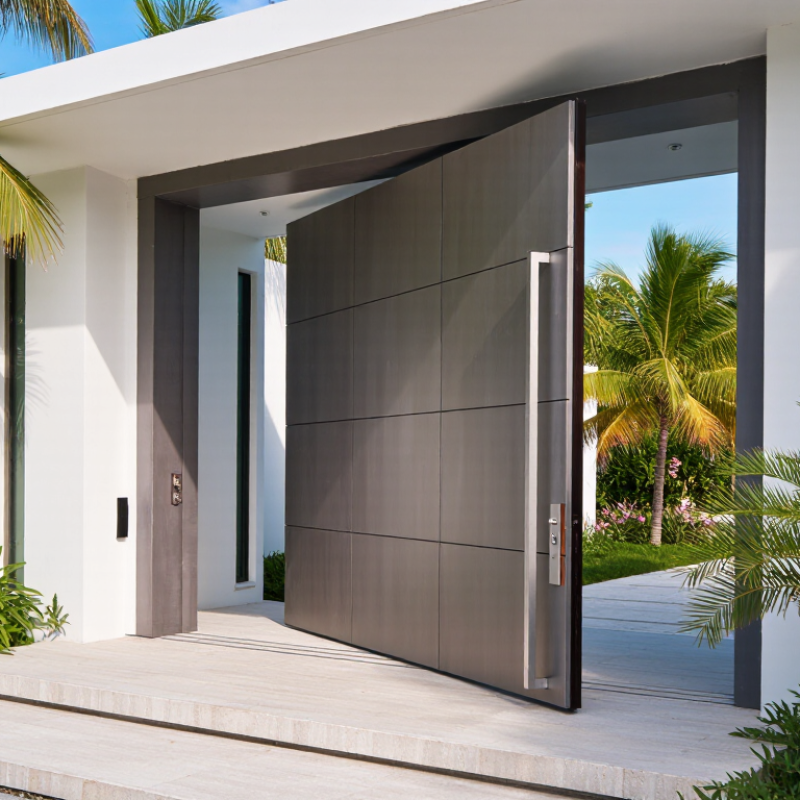
Choosing a pivot door in Miami starts with understanding its type, not its appearance. A center-pivot door rotates from a point near the middle, creating a balanced, dramatic entrance. An offset-pivot door uses a side position, which can provide a wider opening and better furniture clearance. Double pivot doors suit grand foyers, but they require careful alignment and more wall space.

Miami’s humidity, salt air, strong sunlight, and heavy rain affect every exterior installation. I have seen beautiful doors develop alignment problems when installers ignored drainage and structural movement. Choose corrosion-resistant hardware, weather-rated seals, and glass suited to the property’s exposure. A concealed pivot system looks clean, yet it can be harder to inspect and adjust. That trade-off deserves attention.

Tips: Measure the finished opening, not the rough opening. Check the door’s swing path with nearby walls, lights, and furniture. Confirm threshold height and water management before ordering. For coastal homes, ask a qualified local professional to verify materials, anchoring, and applicable building requirements. Global buyers should also request clear drawings, maintenance instructions, and installation records. These details reduce misunderstandings across time zones. The perfect door does not exist. A durable, well-documented choice usually matters more than a flawless showroom image.

How to Choose Pivot Doors in Miami for Global Buyers

Understanding Pivot Door Types for Miami Properties

Miami’s 1991–2020 monthly normal precipitation is highest from June through October, making weather exposure an important consideration when selecting a pivot-door system.

Single Pivot Door

A practical choice for standard residential entrances. Prioritize weather seals, corrosion-resistant hardware, and suitable glazing.

Oversized Single Pivot Door

Creates a stronger architectural statement. Confirm structural support, operating clearance, drainage, and wind-load requirements.

Double Pivot Door

Suitable for wide entryways and larger properties. Review the center meeting detail, threshold performance, and impact-rating requirements.

Data source: NOAA 1991–2020 U.S. Climate Normals, Miami International Airport station. Rainfall values are shown in inches. View NOAA climate normals

Matching Door Materials to Miami’s Climate and Coastal Conditions

Choosing a pivot door in Miami begins with the climate, not the showroom photograph. The city brings intense sun, salt air, sudden rain, and high humidity. These conditions test every material. I have seen beautiful doors lose their finish when owners underestimated daily exposure. A global buyer should ask where the property sits: inland, near Biscayne Bay, or directly on the coast. Distance from saltwater changes maintenance demands.

Marine-grade aluminum offers strong corrosion resistance and a lighter operating feel. Proper powder coating helps protect the surface, but scratches still need prompt attention. Stainless steel can suit pivot hardware, especially with corrosion-resistant grades and sealed fasteners. Avoid mixing metals casually; galvanic corrosion may appear around damp connections. Solid hardwood creates warmth, yet Miami moisture can cause swelling, movement, and uneven gaps. Engineered timber with a durable exterior finish may perform more consistently. It still needs inspection.

Fiberglass can resist moisture and ultraviolet exposure with limited warping. However, its surface quality and internal reinforcement vary by manufacturer. Ask for tested performance data, not only a sample corner. Glass panels should use impact-rated construction where required and include solar-control features for bright entrances. Proper drainage, shaded overhangs, and a reliable threshold matter as much as the slab material. Check hinges after heavy storms. I would rather accept a small design compromise than ignore water intrusion. Even the best door fails when installation leaves gaps, poor seals, or trapped water.

Checking Size, Hardware, Security, and Energy Performance

How to Choose Pivot Doors in Miami for Global Buyers

Checking size is more than measuring the opening. A large pivot door adds drama, but it also increases weight, air leakage, and hardware stress. Leave space for flooring, drainage, and installation tolerances. Ask a qualified installer to verify the wall structure. Small mistakes become expensive later.

Hardware should match the door’s weight and daily use. Stainless steel components resist Miami’s humid, salty air better than untreated metals. Choose adjustable pivots, secure multipoint locking, and concealed fasteners where appropriate. Security should not depend on appearance alone. Miami-Dade’s High-Velocity Hurricane Zone requires tested building components, so buyers should request documented impact and pressure-test performance. Local approval still needs verification.

Energy performance deserves equal attention. The U.S. Department of Energy reports that windows can represent 25–30% of residential heating and cooling energy use. A pivot door with low-emissivity glazing, tight weather seals, and a suitable frame can reduce unwanted heat gain. Check the NFRC labels for U-factor and Solar Heat Gain Coefficient ratings. Lower U-factor means better insulation. Lower SHGC generally limits solar heat entering the home. Yet the best rating depends on orientation, shading, and interior comfort goals. A west-facing glass door may need stronger solar control.

I would not trust a brochure alone. Request test reports, installation details, and warranty conditions in writing. That extra step feels slow, but it can expose weak seals or oversized hardware before delivery.

Navigating Miami Building Codes and Installation Requirements

For global buyers, choosing a pivot door in Miami begins with local code compliance. The Florida Building Code sets requirements for structural safety, energy performance, water resistance, and emergency access. Properties in Miami-Dade’s High-Velocity Hurricane Zone may need tested impact protection and approved assemblies. Confirm this before paying a deposit. Paperwork matters.

A pivot door can weigh hundreds of pounds and place unusual pressure on the frame, hinges, and surrounding wall. Before ordering, an installer should measure the rough opening, wall thickness, floor level, and drainage path. The door assembly may require product approval, engineering documents, and permit review. A licensed local contractor should coordinate inspections with the relevant building department. Small errors spread.

Miami’s heat, salt air, heavy rain, and strong winds make installation details especially important. Use corrosion-resistant hardware and continuous weather seals suited to coastal exposure. The sill must manage water without blocking accessibility or creating a trip hazard. On site, installers should check anchoring, alignment, swing clearance, and the connection between the frame and structure.

Remote buyers should request measured drawings, test documentation, installation photos, and a written scope of work. Ask who handles permits and who remains responsible after inspection. Do not assume imported dimensions match American construction standards. Even experienced teams miss details when plans change late. Review the opening twice. A short delay can prevent expensive repairs, although it may complicate the schedule.

How to Choose Pivot Doors in Miami for Global Buyers - Navigating Miami Building Codes and Installation Requirements

Selection or Compliance Dimension Miami Requirement or Practical Benchmark What to Verify Before Ordering Global Buyer Consideration
Applicable code edition Confirm compliance with the Florida Building Code, 8th Edition (2023), as locally amended and enforced by the relevant Miami-Dade authority having jurisdiction. Ask the architect, permit expediter, or building department which edition and local amendments apply to the property. Do not rely only on a supplier’s general “Florida compliant” statement; approval is project- and jurisdiction-specific.
High-Velocity Hurricane Zone status Miami-Dade County and Monroe County are within Florida’s High-Velocity Hurricane Zone (HVHZ), where stricter opening-protection and testing requirements may apply. Determine whether the site is in the HVHZ and whether the door is part of the permitted building envelope. A door approved for another region may not be acceptable in Miami-Dade without the required local approval documentation.
Product approval documentation Exterior doors generally require a Florida Product Approval, Miami-Dade Notice of Acceptance (NOA), or another approval accepted by the authority having jurisdiction. Obtain the complete approval number, approved configurations, maximum sizes, installation details, and limitations before purchase. Request English-language technical files in PDF format so they can be reviewed by the local design and permitting team.
Wind-load design The required design pressure depends on the building location, mean roof height, exposure, enclosure classification, importance, and opening size. It must be calculated for the specific project. Have the project engineer confirm positive and negative design pressures and compare them with the door approval limits. Avoid selecting a door solely by overall dimensions; wind pressure and anchorage are equally important.
Impact resistance Where required in the HVHZ, glazed or partially glazed assemblies may need large-missile-impact protection or an approved impact-resistant construction. Check testing and approval to applicable TAS 201, TAS 202, and TAS 203 procedures, or the testing specified by the approval. Confirm that the impact rating covers the exact glass, frame, hardware, and size combination being ordered.
Door size and clear opening For an accessible route, a common minimum benchmark is 32 inches of clear opening measured with the door open 90 degrees; the adopted code and project type control. Measure clear width, clear height, swing or pivot movement, threshold, and adjacent wall conditions—not only the rough opening. Large pivot leaves can reduce usable clearance and require stronger structure, wider delivery access, and more installation space.
Threshold and water management The threshold, sill pan, flashing, drainage, and surrounding wall interface must match the approved assembly and Miami’s wind-driven-rain conditions. Request section details showing sill slope, pan flashing, sealants, weep paths, and transition to the finished floor. Imported installation methods may not provide the drainage and flashing details required for South Florida exposure.
Structural support Pivot hinges transfer substantial vertical and lateral loads to the head, sill, jambs, and adjacent structure; support must be designed for the selected assembly. Provide the structural engineer with the door weight, hinge reactions, fastener schedule, substrate type, and required reinforcement. Concrete, masonry, steel, and wood framing require different anchoring details and should not be treated as interchangeable.
Anchorage and fasteners Fasteners, spacing, embedment, edge distances, and corrosion resistance must follow the approved installation instructions and the supporting structure design. Confirm approved fastener type and material, especially for coastal locations exposed to salt air and moisture. Stainless or otherwise approved corrosion-resistant hardware may be necessary, but the approval documents control the final specification.
Glass and energy performance Glazing may need safety glazing, impact protection, and compliance with Florida energy requirements applicable to the project. Verify safety-glazing markings, U-factor, solar heat gain coefficient, visible transmittance, and the approved glass composition. Aesthetic glass substitutions can invalidate the approval or change thermal and impact performance.
Hardware and locking Locks, multipoint systems, cylinders, handles, closers, and hold-open devices must be compatible with the approved door assembly and the required egress function. Confirm egress operation, emergency release, corrosion resistance, weather sealing, and compatibility with access-control systems. International lock formats may not match local life-safety hardware or security requirements.
Permit package Permit submissions commonly require product approvals, architectural details, structural attachment information, energy documentation, and site-specific design pressures. Coordinate the door schedule, shop drawings, approval documents, engineering calculations, and installation details before fabrication. Allow time for review comments and revisions; fabrication should not begin from an unapproved concept drawing.
Installation quality control Installation must follow the approved instructions, including frame alignment, shims, sealants, fasteners, flashing, and adjustment of pivot hardware. Use qualified local installers familiar with Miami-Dade permitting, wind-rated openings, waterproofing, and inspection procedures. International remote supervision is useful, but it should not replace local field verification and inspection coordination.
Delivery and site logistics Oversized pivot doors may require protected storage, lifting equipment, adequate access routes, and temporary weather protection before installation. Confirm crate dimensions, total weight, unloading method, elevator or stair limitations, storage conditions, and damage-inspection procedures. Include customs, inland transport, insurance, replacement-part availability, and lead time for approved hardware or glass.

Code requirements can vary by property, occupancy, location, and permit jurisdiction. Final dimensions, design pressures, product approvals, and installation details should be confirmed by the project architect, engineer, and local building authority.

Comparing Suppliers, Costs, Shipping, and After-Sales Support

Choosing a pivot door in Miami starts with the supplier, not the showroom photograph. Global buyers should request factory drawings, hardware specifications, finish samples, and recent project references. A serious supplier explains thermal performance, wind exposure, drainage, and glass options in plain language. Ask who measures the opening. Errors here become expensive quickly. Compare at least three written quotations. Each quote should separate the door, frame, hardware, packaging, freight, insurance, duties, and installation. Low prices often hide missing services. That lesson is easy to forget.

In Miami, salt air and strong sun make material selection practical, not decorative. Marine-grade finishes and corrosion-resistant hardware usually cost more, but replacement is rarely cheap. Buyers should compare total landed cost rather than the factory price alone. Request the shipping method, estimated transit time, crate dimensions, and delivery responsibility. Confirm whether the crate includes moisture protection. A damaged door can wait at a port while paperwork moves slowly. That happened on one project I reviewed. The buyer saved on freight, then paid heavily for storage and rework. Shipping estimates are not promises.

After-sales support deserves the same scrutiny as engineering. Get response times, spare-parts procedures, installation guidance, and warranty exclusions in writing. Ask whether remote troubleshooting uses drawings, photos, or video calls. For international owners, a local installer familiar with large pivot systems can prevent alignment problems. Check hinge adjustment access before ordering. Some suppliers sound confident until a seal fails. I would also request a packing inspection record and final operating video. These details feel minor. They are not. Still, careful comparisons can miss site conditions, especially in older Miami buildings.