
Choosing a Solid 27mm 3 Layer Yellow Formwork panel requires more than comparing color, price, or advertised thickness. On active construction sites, panel performance affects concrete finish, labor time, safety, and material waste. The yellow surface usually indicates a film-faced plywood product, but appearance alone proves little.
Industry outlooks from Grand View Research and Research and Markets identify reusable formwork and engineered wood products as important construction-market segments. Their findings point toward demand for durable, cost-efficient systems that reduce replacement frequency. However, market reports provide direction, not a buying decision. A professional assessment should examine the panel’s core species, veneer quality, adhesive class, moisture resistance, edge sealing, and measured thickness.
Start with the technical data sheet. Confirm the panel has three bonded layers, a true 27mm thickness, and a consistent face film. Inspect a sample edge for open gaps, overlaps, or dark glue lines. Place the panel flat and check for warping under side lighting. Small defects matter.
They do.
Relevant plywood standards, such as EN 13986 and EN 13353, can support a structured evaluation, while project specifications may require additional bending or bond-strength testing. Ask suppliers for batch test records, formaldehyde documentation, and verified reuse guidance. Some sellers claim high reuse cycles without defining concrete pressure, cleaning methods, or site conditions. That is a weakness.
In practice, the best Solid 27mm 3 Layer Yellow Formwork panel balances stiffness, surface quality, weight, and repeat-use potential. Compare delivered cost per casting cycle, not simply cost per sheet. A careful trial pour remains valuable. Data can guide the choice, but real concrete often exposes assumptions.
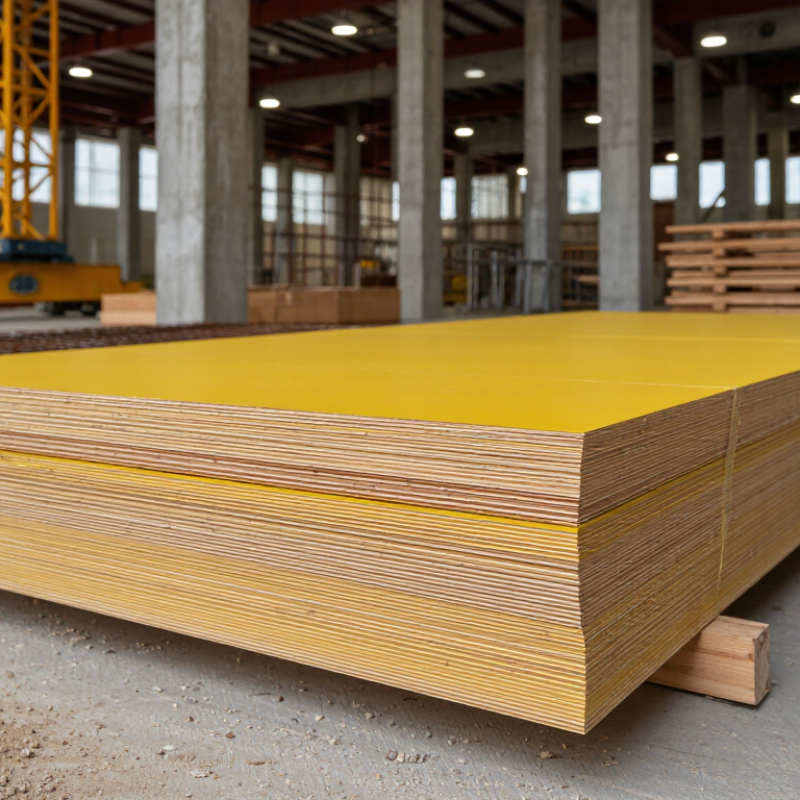
How to Choose Solid 27mm 3 Layer Yellow Formwork Panel?
A solid 27mm three-layer yellow panel should be judged beyond its bright surface. The core feature is structural consistency. A practical density range of 550–700 kg/m³ gives an estimated weight of 14.9–18.9 kg/m². This affects lifting, frame pressure, and installation speed. USDA Forest Products Laboratory’s Wood Handbook notes that wood products respond strongly to moisture changes. Therefore, stable moisture content matters. Ask for factory moisture records, not only appearance.
The three-layer structure should have balanced veneers and tight bonding. The face layers need low-defect surfaces. The central layer should resist splitting around screws and tie holes. Check bonding quality against EN 314-2 or an equivalent standard. Water-resistant adhesive is essential for repeated concrete contact. A yellow film can improve release and cleaning. It cannot repair weak plywood. I have seen glossy panels fail at the edges after limited use. That was an avoidable mistake.
Edge sealing deserves close attention. Look for even coating, no open gaps, and square corners. According to ASTM D1037 testing practice, thickness swelling, water absorption, and bending performance should be measured under controlled conditions. Request recent test results, including modulus of elasticity and bond strength. A flat panel should remain stable after conditioning. This is where many claims become vague. I would also inspect three random sheets from each batch, because one perfect sample proves very little.
Choosing a solid 27mm 3 layer yellow formwork panel requires more than checking its color. Materials come first. Look for balanced softwood or hardwood veneers, waterproof bonding, and consistent grain direction. The USDA Wood Handbook, FPL-GTR-190, notes that wood moisture changes can affect dimensions and strength. Therefore, inspect panels after delivery, not only from catalog images. A damp core is a warning.
Measure thickness, length, width, squareness, and edge sealing. A true 27mm panel should not show obvious swelling or thin corners. EN 315 provides guidance on plywood dimensional tolerances. Compare the supplier’s declared values with actual samples. Surface quality matters during concrete release. The face should feel smooth, without open knots, bubbles, sanding waves, or exposed veneer joints. Small defects may print clearly onto fresh concrete. They often look harmless. They are not always harmless.
Structural strength needs test evidence. Request bending strength, modulus of elasticity, bonding class, and allowable deflection data. ACI 347R explains that formwork pressure changes with pour speed, concrete temperature, slump, and vibration. One panel rating cannot fit every project. Tips: Check three random panels. Weigh one sample. Record moisture and thickness. Ask for test dates and laboratory accreditation. I would also review the panel layout again; three layers may reduce cost, but poor core alignment can weaken screw holding and edge durability.
Compare the nominal thickness, layer count, common panel dimensions, and bending-strength reference before purchasing. Confirm the actual figures with inspection records, technical data sheets, and project requirements because specifications can vary by manufacturer and application.
A suitable panel should have uniform three-layer construction, a measured thickness close to 27 mm, stable dimensions, a smooth sealed surface, and documented structural performance. Check for warping, open joints, delamination, edge damage, and surface bubbles before use.
Choosing a solid 27mm, three-layer yellow formwork panel starts with the concrete requirement, not the color. Normal-weight concrete weighs about 2,400kg/m³, as referenced in ACI 347R-14. Fresh pressure increases with pour height, placement speed, vibration, and temperature. A tall wall pour needs stronger support spacing than a short foundation wall. Panel thickness alone cannot prove suitability.
Check the panel’s bending strength, modulus of elasticity, allowable deflection, edge strength, and moisture resistance. These values should come from factory test reports, preferably using recognized methods such as EN 789 or ASTM D1037. A three-layer structure can reduce warping when its veneers are balanced and properly bonded. However, poor bonding remains a risk.
Inspect cut edges, exposed core gaps, surface blisters, and uneven yellow film before installation.
Measure the actual support spacing against the design load. ACI 347R recommends designing formwork for fresh concrete, construction workers, equipment, and impact effects. The USDA Forest Products Laboratory’s Wood Handbook also explains that wood-based panels change dimensions with moisture. Seal damaged edges quickly. Keep panels flat, dry, and raised from standing water.
On site, a clean release agent and careful stripping can protect the face for more cycles. Still, reuse claims require evidence from comparable pours, not optimistic estimates. A small test pour may reveal deflection, grout leakage, or surface marking before a large project exposes the weakness.
Choosing a solid 27mm, three-layer yellow formwork panel starts with its reuse potential, not its appearance. On active sites, I inspect edges, corners, screw holes, and surface film before accepting delivery. A flat panel with sealed edges usually survives more cycles than one showing early swelling. Ask for test data, manufacturing records, and declared tolerances. Color proves little.
Reuse depends on handling as much as board construction. Workers should lift panels instead of dragging them across aggregate or steel. A thin, even release agent helps, while excess oil can stain concrete and weaken joint control. After stripping, I record dents, edge separation, resin loss, and visible deflection. One missed inspection can reduce the next cycle. I have seen panels removed too early and damaged despite good initial quality. It changed our checklist.
Safety evaluation should cover load capacity, bending performance, slip resistance, and compliance documents for the project location. Confirm that the panel matches the planned pour height, concrete pressure, support spacing, and fastening method. Wet, cold, or humid sites need protected storage above standing water. In hot weather, exposed panels may warp before installation. Keep walkways clear. A panel can meet a published standard yet fail when supports are poorly aligned. Site conditions deserve equal attention.
When selecting a solid 27mm, three-layer yellow formwork panel, compare landed cost rather than the factory quote. Turner & Townsend’s 2024 International Construction Market Survey reported 3.6% average construction-cost inflation across its global city sample. Freight, handling, and exchange rates can quickly erase a small price advantage. Request quotations showing panel price, packing, loading, insurance, duties, and delivery terms separately. Ask for core density, thickness tolerance, surface coating, and documented reuse performance. A low-cost panel may fail earlier. That risk deserves a number.
Warranty language needs careful reading. A serious supplier should state coverage length, allowable defects, moisture limits, and claim procedures. “Quality guaranteed” is not enough. Require batch records, inspection reports, and sample testing before purchase. The USDA Forest Products Laboratory’s Wood Handbook identifies moisture movement as a key factor affecting wood-based panel performance. Therefore, storage guidance matters as much as the warranty. I would also check whether repairs, edge swelling, or ordinary wear are excluded. They often are.
Delivery capability can decide a project. Dodge Construction Network’s 2024 outlook projected an 8% rise in U.S. construction starts, which may increase pressure on panel availability. Compare confirmed production dates, port options, minimum order quantities, and replacement procedures. Request photos of sealed bundles and container loading. Track promised dates against actual arrivals. Do not trust a perfect schedule. It may be optimistic. A practical supplier offers realistic lead times, buffer stock, and clear communication when production slips. Keep every promise in writing.
| Anonymous Supply Option | Panel Construction | Standard Size | Surface and Edge Finish | Core Technical Data | Indicative Cost per Panel | Minimum Order | Warranty Coverage | Typical Production and Delivery | Best-Fit Application | Selection Assessment |
|---|---|---|---|---|---|---|---|---|---|---|
| Supplier A Export Grade | Three-layer solid hardwood construction with balanced face and back veneers; waterproof phenolic film bonded to both faces. | 2440 × 1220 × 27 mm Approx. 35–39 kg per panel | Yellow phenolic film, approximately 220 g/m²; sealed edges with waterproof paint. | Repeated-use target: 10–15 cycles with proper cleaning and support. Moisture-resistant adhesive suitable for concrete formwork. Typical thickness tolerance: ±0.5 mm. | US$39–48 | 1 × 20-foot container Approximately 450–520 panels, depending on packing. | 12 months against manufacturing defects; excludes misuse, prolonged water exposure, and unsupported overloading. | 18–25 days production; approximately 25–40 days by sea after dispatch, depending on destination and port conditions. | General building slabs, walls, columns, and medium-turnover commercial projects. | ★★★★☆ Strong balance of price, durability, and export availability. |
| Supplier B Heavy-Duty Grade | Three-layer hardwood panel with denser inner layer and enhanced face veneer selection for improved stiffness and surface consistency. | 2500 × 1250 × 27 mm Approx. 38–43 kg per panel | Yellow phenolic film, approximately 240 g/m²; factory-sealed edges with higher resistance to edge swelling. | Repeated-use target: 15–20 cycles under controlled site conditions. Typical modulus and load performance is higher than standard panels because of denser core material. Typical thickness tolerance: ±0.5 mm. | US$46–58 | Approximately 350–450 panels per container; final quantity depends on loading plan. | 18 months against delamination, adhesive failure, and abnormal core separation; normal wear is excluded. | 22–30 days production; approximately 25–40 days by sea after dispatch. | High-repetition wall and slab formwork where lower replacement frequency is important. | ★★★★★ Highest durability potential, but with a higher purchase price and heavier handling. |
| Supplier C Cost-Control Grade | Three-layer mixed hardwood panel with standard core selection and waterproof adhesive. | 2440 × 1220 × 27 mm Approx. 34–38 kg per panel | Yellow phenolic film, approximately 180–200 g/m²; standard edge coating. | Repeated-use target: 6–10 cycles with careful stripping and storage. Suitable for standard temporary concrete formwork. Typical thickness tolerance: ±0.6 mm. | US$32–40 | Approximately 500–600 panels per container. | 6 months against manufacturing defects; water damage, impact damage, and improper storage are excluded. | 15–22 days production; approximately 25–40 days by sea after dispatch. | One-off projects, budget-sensitive work, and low-to-medium repetition requirements. | ★★★☆☆ Lowest entry price, but expected service life and film durability should be verified by samples. |
| Supplier D Fast-Delivery Grade | Three-layer solid hardwood panel manufactured from regularly stocked specifications for shorter lead times. | 2440 × 1220 × 27 mm Approx. 35–40 kg per panel | Yellow phenolic film, approximately 220 g/m²; sealed edges and protective export packaging. | Repeated-use target: 10–15 cycles with correct handling. Standard waterproof bonding system. Typical thickness tolerance: ±0.5 mm. | US$41–50 | Approximately 250–350 panels, subject to available inventory. | 12 months against production defects; replacement or credit normally requires inspection evidence. | 7–14 days when stock is available; approximately 25–40 days by sea after dispatch. | Urgent repair work, schedule-critical projects, and partial replenishment orders. | ★★★★☆ Best delivery flexibility, although stock quantity and batch consistency require confirmation. |
| Supplier E Certified Quality Grade | Three-layer hardwood panel with documented raw-material grading, controlled pressing, and batch traceability. | 2500 × 1250 × 27 mm Approx. 37–42 kg per panel | Yellow phenolic film, approximately 220–240 g/m²; four-side edge sealing and moisture-protection packaging. | Repeated-use target: 12–18 cycles, depending on concrete mix, release agent, and stripping method. Batch inspection records available for thickness, bonding, and appearance. Typical thickness tolerance: ±0.5 mm. | US$48–62 | Approximately 300–400 panels per container. | 18 months against manufacturing defects, subject to batch records and correct storage; wear and site damage are excluded. | 25–35 days production; approximately 25–40 days by sea after dispatch. | Projects requiring quality documentation, repeatable batches, and formal procurement controls. | ★★★★☆ Best documentation and quality-control profile, with the highest landed-cost risk. |
| Comparison basis: Prices are indicative USD export ranges per 27 mm panel and normally exclude local taxes, import duties, inland delivery, and installation. Actual prices vary with timber species, film weight, order volume, packaging, exchange rates, freight rates, and destination. Before ordering, request a sample, technical data sheet, recent inspection report, written warranty terms, confirmed container loading quantity, and a delivery schedule. | ||||||||||


