
China Top 10 Banner Stands Suppliers for Global Buyers begins with a practical question: who can deliver dependable quality beyond attractive catalog photos? This guide examines China-based manufacturers serving international exhibitions, retail spaces, conferences, and mobile marketing campaigns. It considers frame stability, print sharpness, fabric tension, replacement parts, packaging, production capacity, and export communication. These details matter when a Banner Stands shipment arrives days before an event.
Marlys K. Arnold, an exhibition marketing authority and author of Build a Better Trade Show Image, has said, “Trade shows are not about selling; they are about building relationships.” That principle also applies to supplier selection. A reliable manufacturer should understand how graphics look under exhibition lighting, how aluminum profiles survive repeated assembly, and how compact cases protect hardware during transport. Certifications can support trust, but they do not replace samples, factory communication, or inspection.
No ranking is perfect. Buyer priorities differ.
Some companies excel at custom printing. Others offer faster standard models or stronger after-sales support. This overview compares those differences for global buyers seeking practical value, not exaggerated promises. It also highlights areas requiring direct verification, including material thickness, color consistency, warranty terms, and delivery schedules. A supplier may appear impressive online yet perform unevenly on a real order. That possibility deserves attention. By combining documented capabilities, product evidence, and buyer-focused criteria, this selection aims to make Banner Stands sourcing clearer, safer, and more informed.
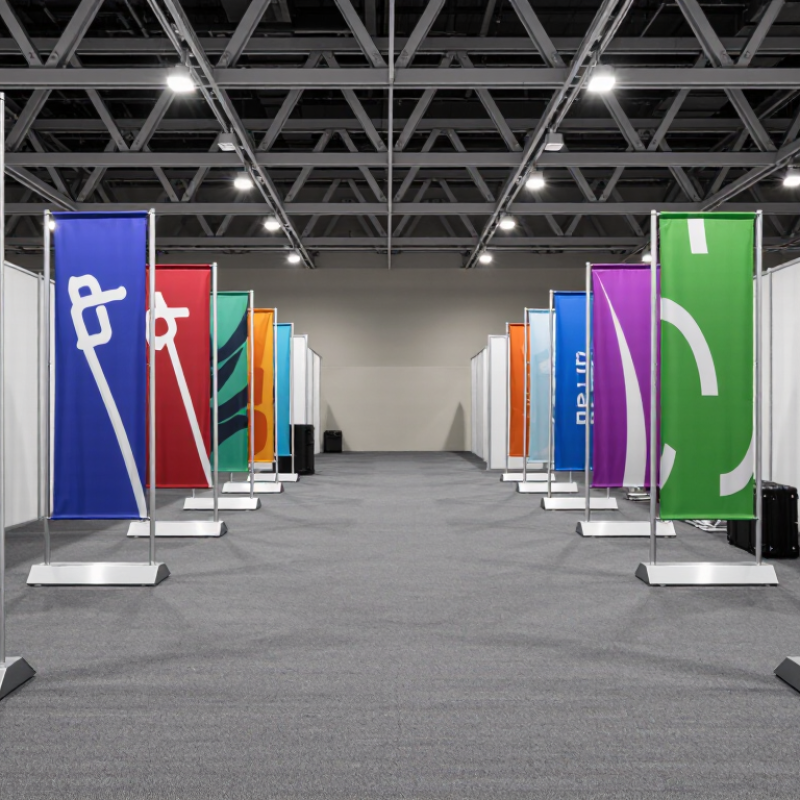
Banner stands serve different environments, and selection should follow the visitor journey. Retractable stands suit hotel lobbies, retail entrances, and conference aisles. Their cassette protects the printed graphic during transport. X-frame and L-banner stands are lighter and economical for repeated regional events. They work well beside registration desks. Tension-fabric stands create larger backdrops for press walls, product demonstrations, and recruitment zones. Outdoor telescopic systems need weighted bases and weather-resistant materials.
The UFI Global Exhibition Barometer, 2024 edition, reported that exhibition activity recovered to approximately 97% of 2019 levels in 2023. This recovery increases demand for portable, reusable displays. The Global Association of the Exhibition Industry also highlights sustainability as a growing buyer priority. Therefore, replaceable graphics and recyclable hardware matter more than decorative complexity. In practice, a 600-millimeter-wide retractable unit can fit narrow corridors, while a 3-meter fabric wall needs careful loading access.
Global applications require more than attractive printing. Buyers should check fire ratings, language versions, wind resistance, and assembly instructions before shipment. Indoor models may fail outdoors. That mistake is common. The International Organization for Standardization’s ISO 7010 principles also support consistent safety symbols across international venues. However, banner stands rarely solve every communication problem. A crowded aisle can hide small text, and excessive graphics weaken the message. Test viewing distance, lighting, and transport weight with real users before placing large orders.
When evaluating Chinese banner stand suppliers, production experience matters more than a polished catalog. Ask how many years they have produced retractable, tension fabric, or outdoor display systems. Request sample units, not only product photos. Inspect the base weight, pole joints, cassette alignment, and print tension. Small defects become obvious under exhibition lighting.
Material control is another practical test. Reliable suppliers should identify aluminum grades, fabric composition, printing methods, and packaging protection. Ask for load tests, color consistency records, and quality inspection procedures. Independent certifications may support credibility, but buyers should verify their scope and validity. A certificate alone proves little. Factory audits, video inspections, and clear pre-shipment standards provide stronger evidence.
Communication can decide whether an order succeeds. Evaluate response speed, technical drawings, production schedules, and their handling of revisions. Confirm minimum order quantities, replacement policies, spare parts, and shipping terms in writing. Compare total landed cost, not just the unit price. Low prices may conceal thin materials, weak packaging, or inconsistent printing. However, higher prices do not automatically guarantee better quality. No checklist is perfect. A supplier may pass a sample inspection and still struggle with large-volume consistency. Start with a controlled trial order, record every issue, and judge how openly the supplier corrects mistakes. Reliable cooperation is demonstrated after problems appear.
China’s top ten banner stand suppliers serve different buyer priorities. One specializes in lightweight roll-up stands for exhibitions and short campaigns. Another focuses on heavy-duty aluminum frames for repeated installation. A third offers fabric displays with silicone-edge graphics and clean tension. The remaining profiles include suppliers known for outdoor bases, portable counters, modular backdrops, custom packaging, rapid sampling, large-volume production, and private-label support.
The profiles assess practical experience, production control, and export readiness. Experienced suppliers usually provide material samples, assembly videos, and measured load information. Stronger factories inspect aluminum thickness, print alignment, locking parts, and carry-bag stitching. Some maintain automated cutting equipment, while others rely on skilled manual assembly. That difference can affect consistency. Ask for recent product photos.
Reliable suppliers also explain lead times clearly. They should confirm artwork requirements, carton dimensions, replacement-part policies, and inspection procedures before payment. A supplier with flexible customization may handle unusual sizes well, but customization can increase errors. Simpler models often deliver more predictable results. Buyers should request a pre-production sample for large orders.
No profile is flawless. A supplier may offer excellent printing but limited after-sales support. Another may provide strong hardware yet use slower packaging processes. Reviews, factory audits, sample testing, and shipment records create a more dependable decision. The best match depends on event frequency, transport conditions, budget, and the skill of the local installation team.
China Top 10 Banner Stands Suppliers for Global Buyers
When comparing China’s top ten banner stand suppliers, product range matters more than catalog size. Some offer retractable stands, outdoor bases, tension frames, and tabletop displays. Others focus on one format and control production more carefully. In my sourcing experience, stable aluminum frames and smooth roller mechanisms reduce problems during repeated events. A stand may look attractive online, yet its locking points can feel weak after several uses. Product samples remain essential.
Customization separates average suppliers from dependable production partners. Buyers should confirm print materials, dimensions, colors, carrying cases, and packaging details. Ask for digital proofs before mass production. Quality checks should cover fabric alignment, edge finishing, pole strength, and carton protection. Pricing requires a complete comparison. A low unit quote may exclude printing, tooling, shipping, or replacement parts. My early comparisons focused too heavily on price. That was a mistake.
Tips: Request one sample, one inspection report, and one complete quotation. Compare identical specifications, not attractive headline prices. Check communication speed and technical answers. A supplier that admits a limitation may be more reliable than one promising everything. Lead times also deserve attention, especially before exhibitions. Even experienced buyers can overlook small accessories, and those missing parts can delay installation.
Choosing a banner stand supplier in China requires more than comparing catalog prices. Global buyers should create a shortlist based on product range, export experience, production capacity, and communication quality. Request factory photos, business documents, material specifications, and recent project references. A polished catalog is not enough. Verify whether the supplier actually manufactures the stands or outsources key components.
Ask for a sample before placing a large order. Check the frame’s stability, printed color, base weight, carrying case, and folding mechanism. Measure the packed size yourself. It affects freight costs and warehouse handling. Request a detailed quotation with product dimensions, packaging, minimum order quantity, lead time, payment terms, and shipping conditions. Clear documents prevent expensive assumptions.
Use a written quality agreement before production begins. It should define acceptable color variation, scratches, missing parts, and replacement procedures. Confirm that materials and inks meet the destination market’s safety requirements. A pre-shipment inspection can catch loose joints or weak packaging. Still, inspections are not perfect. Buyers should keep photos, approved samples, and signed specifications for reference. Select secure payment methods, confirm customs responsibilities, and test the supplier’s response when problems appear. Slow answers before payment may become slower after payment.
| Step | Evaluation Dimension | Information to Request | Practical Benchmark or Evidence | Recommended Buyer Action |
|---|---|---|---|---|
| 1 | Product Range | Available banner stand categories, sizes, frame systems, bases, lighting options, and replacement parts. | The supplier should provide a current product specification sheet with dimensions, net weight, packed size, materials, and compatible accessories. | Shortlist suppliers whose standard range matches the intended display environment and transport requirements. |
| 2 | Material and Construction | Aluminium alloy grade or profile, steel components, fabric or PVC media, base stability, surface finish, and hardware details. | Request material declarations, component drawings, load or stability information where relevant, and clear close-up product photos. | Compare durability, portability, corrosion resistance, and ease of assembly rather than judging on price alone. |
| 3 | Printing and Color Accuracy | Supported artwork formats, printing process, color-management method, finishing options, and fabric or graphic replacement procedure. | A professional supplier should confirm artwork templates, printable dimensions, bleed requirements, color references, and pre-production approval procedures. | Approve a physical color sample or proof for brand-critical projects before authorizing mass production. |
| 4 | Customization Capability | Custom dimensions, structural modifications, packaging design, private labeling, accessory development, and engineering support. | Require a written feasibility assessment, drawing revision process, tooling charges if applicable, and ownership terms for approved artwork or designs. | Use standard models for speed and cost control; select customization only when it delivers a clear marketing or installation benefit. |
| 5 | MOQ and Sample Policy | Minimum order quantity, sample price, sample lead time, sample freight, and whether sample charges are refundable after a bulk order. | A transparent quotation should separate product cost, printing, packaging, tooling, sampling, and delivery charges. | Order one complete sample set for first-time cooperation, including the stand, graphic, carrying case, and accessories. |
| 6 | Production Capacity and Lead Time | Monthly capacity, production schedule, peak-season planning, material availability, and confirmed sample and bulk lead times. | Lead time should be stated separately for sampling, printing, assembly, inspection, and dispatch, with the order trigger clearly defined. | Build schedule buffers for artwork approval, public holidays, inspection, customs clearance, and final-mile delivery. |
| 7 | Quality Control | Incoming material checks, in-process inspections, final inspection standards, defect classification, and inspection records. | Confirm checks for dimensions, color, print defects, stitching, mechanical fit, accessories, packaging quantity, and carton condition. | Use an agreed inspection checklist and, for larger orders, arrange independent pre-shipment inspection before balance payment. |
| 8 | Packaging and Export Readiness | Individual packaging, carton dimensions, gross weight, palletization, shipping marks, product labels, and export documentation. | The quotation should include packing details needed to calculate cubic volume, freight cost, warehouse handling, and import requirements. | Confirm whether packaging is suitable for parcel, air, sea, or mixed-mode transportation before placing the order. |
| 9 | Trade Terms and Landed Cost | Currency, payment schedule, Incoterms® 2020 option, freight quotation validity, duties, taxes, insurance, and destination charges. | Compare total landed cost under the same delivery term; product price alone is not sufficient for supplier comparison. | Obtain a pro forma invoice that itemizes product, printing, packaging, freight, and any tooling or service fees. |
| 10 | After-Sales Support and Reordering | Warranty scope, spare-part availability, replacement policy, complaint response time, reorder process, and graphic reprint capability. | The supplier should provide written warranty terms and define remedies for manufacturing defects, missing parts, transit damage, and print errors. | Keep approved specifications, artwork files, inspection records, and packing instructions for consistent future orders. |


